

What TANIQ's robotic winding systems actually do
From complex geometries to multi-process production lines, TANIQ's robotic platform is built around four capabilities that define what your next composite program can achieve.
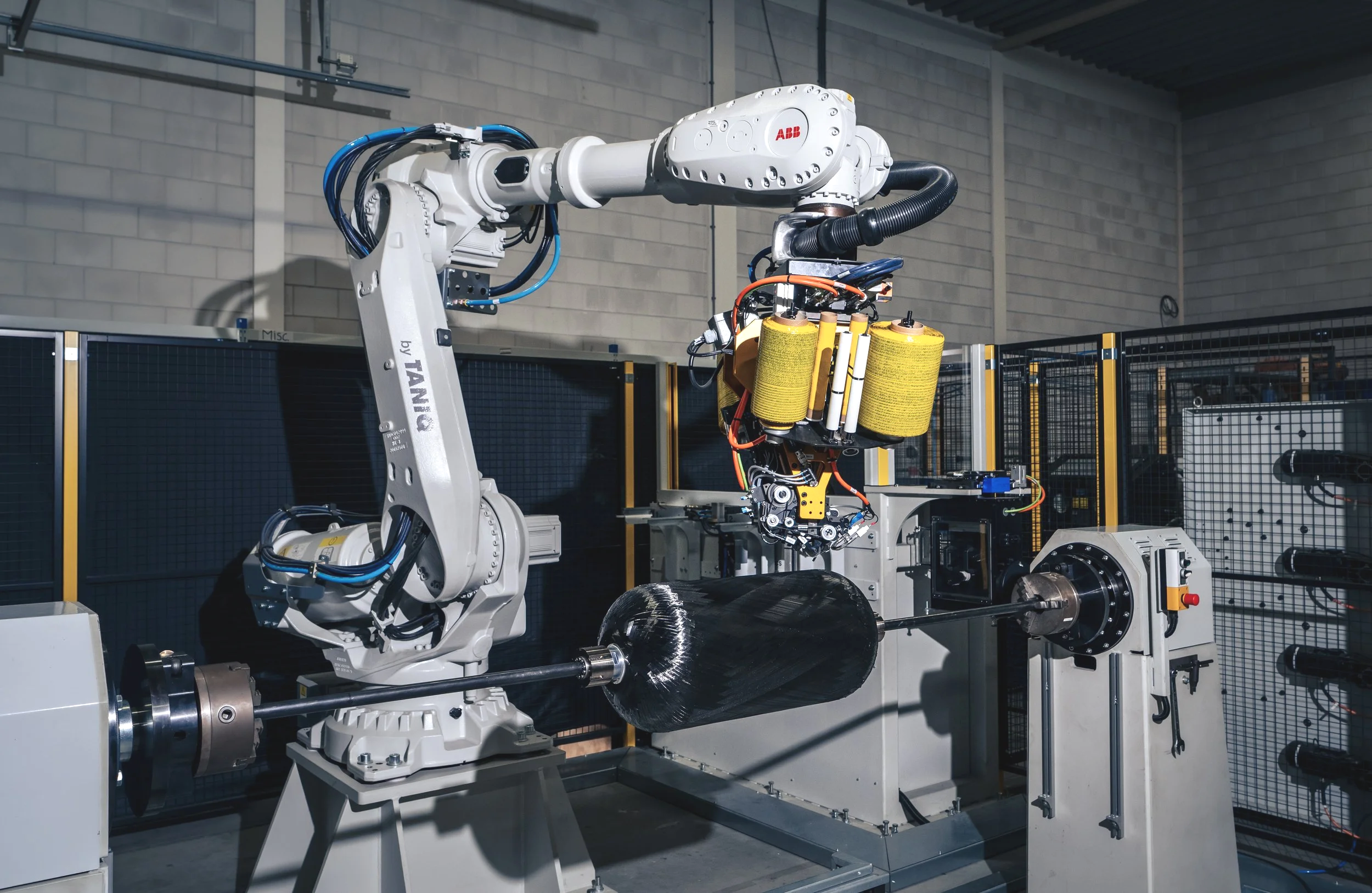
A 6-axis robot combined with track, mandrel rotation, and tool orientation axes gives the machine a full working envelope — enabling fiber placement on thrusters, curved airframe sections, and non-cylindrical geometries that fixed-axis systems can't reach.
Configurable for different part sizes, tooling setups, and process combinations. When requirements change between programs, the system adapts — supporting prototyping, development, and production on a single platform.
Combine filament winding with AFP or rubber winding on a single robotic platform. No separate machines, no extra handling — reducing cycle time and increasing consistency across complex layup sequences.
TaniqWind Pro lets you simulate winding paths, optimize fiber angles, and validate designs digitally before a single fiber is laid — shortening development cycles and reducing material waste.
One platform. Five ways to wind.
From simple axisymmetric parts to complex, non-axisymmetric geometries, TANIQ's robotic winding systems reconfigure to match your production needs — without swapping machines.
Track-mounted arm with the mandrel supported lathe-style at both ends.
Arm moves the mandrel directly while a fixed delivery eye feeds fiber.
Track-mounted arm follows curved, tapered, non-cylindrical forms.
Arm holds a vertical mandrel while a separate delivery eye feeds fiber.
Adaptive fiber placement, including doily patterns at dome ends.
Watch TANIQ's robotic winding system at work
Already using CNC winding? Here's how robotic winding compares.
CNC filament winding is a proven, efficient technology for rotationally symmetric composite parts. Robotic winding doesn't replace it — it extends what's possible. For programs that demand more geometric freedom, multi-process capability, or future adaptability, the differences matter.
← Scroll to see full table
| Capability | Traditional CNC Winder | TANIQ Robotic System |
|---|---|---|
| Degrees of freedom | 2–4 fixed axes: mandrel rotation, carriage travel, cross-feed, delivery eye | ✓6-axis robot + track (1) + mandrel rotator (1) + twist (1) + more if needed |
| Multi-process integration | ✗Single-process machine architecture | ✓Multiple tools and processes on one platform |
| Prototyping & low-volume A&D | ✗High retooling overhead for small runs | ✓Designed for agile development cycles |
| Complex geometry capability | Optimized for cylindrical mandrels only | ✓Extendable with AFP head for non-axisymmetric placement |
| Program-to-program adaptability | ✗Fixed layout — refixturing required per part family | ✓Modular architecture reconfigures across programs |
Built for the parts that push boundaries
TANIQ systems serve the most demanding composite manufacturing programs in aerospace, defense, and space launch.
Discuss your winding challenge with TANIQ
Talk to a TANIQ engineer about your current program — and the geometries you've been working around.
For A&D programs requiring NDA-first engagement, contact us directly at info@taniq.com