
Integrating Filament Winding, AFP & Rubber Winding into a Single Unified Design & Manufacturing System
Advanced composite products are no longer built from a single material or process. Today’s high-performance structures — from hydrogen pressure vessels to rocket motor cases — increasingly rely on multi-material, multi-process architectures to optimize strength, weight, production speed, and cost.
Yet manufacturing workflows have not been able to keep pace with this evolution.
Traditionally, each process — filament winding, automated fiber placement (AFP), and rubber winding — requires its own software package and dedicated machine. This traditional setup introduces data transfers, manual rework, machine changeovers, and unnecessary risk.
TANIQ addresses this challenge by integrating multiple reinforcement processes into one unified software environment and one automated robotic cell.
The Industry Challenge: Disconnected Processes
Consider a composite pressure vessel. Production can be optimized by:
Using high-speed filament winding for the cylindrical body
Applying precise AFP reinforcement in the dome areas
Integrating rubber layers for sealing, insulation, or protection
In a conventional setup, this means:
Designing layers in different software platforms
Exporting and re-importing geometry files
Manual rebuilding of layers
Physically transferring the product between machines
Each additional interface increases complexity, error sensitivity, and lead time. The solution is not simply adding another machine — it is integrating the entire workflow.
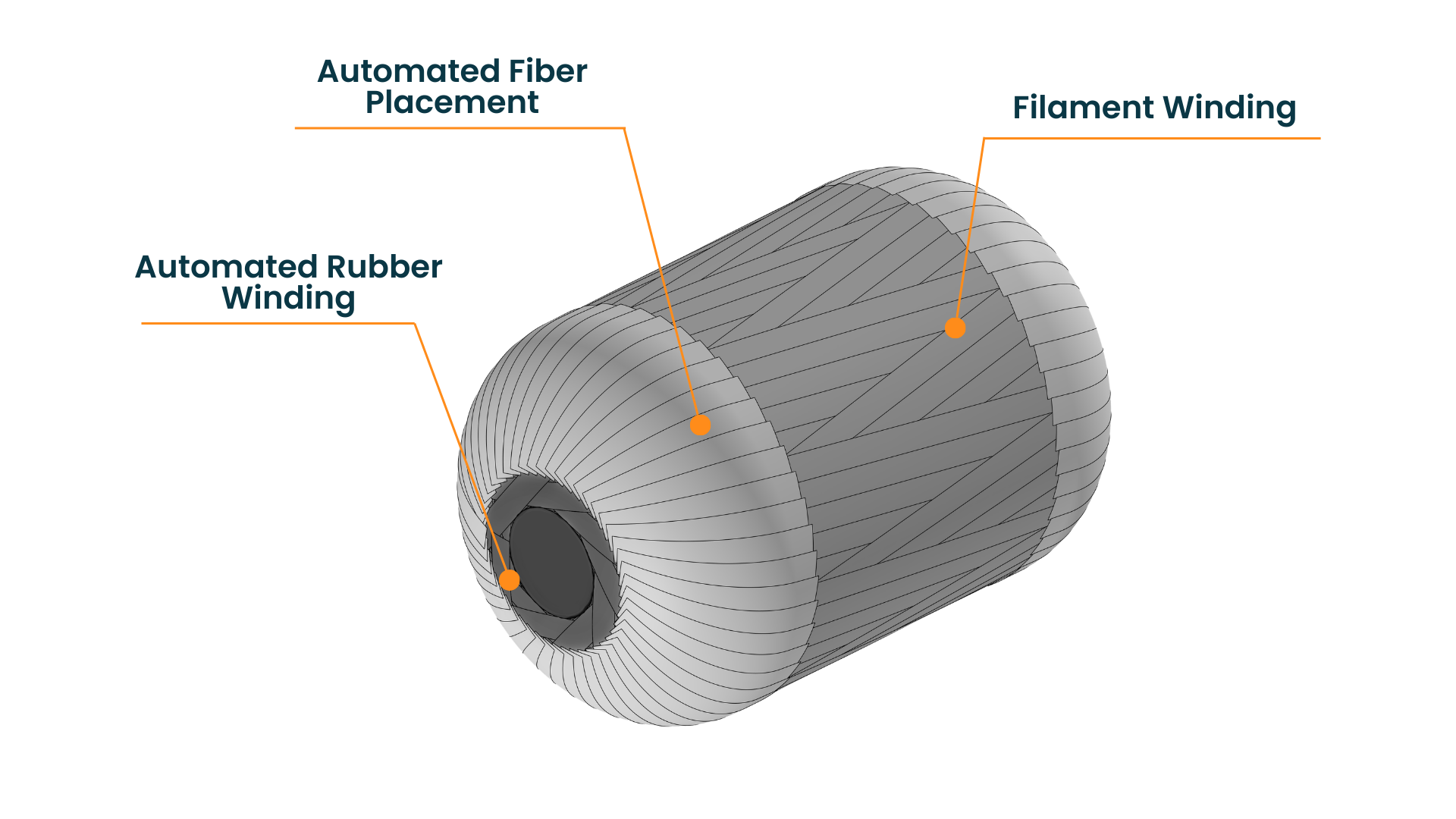
Multiple materials designed in TaniqWind Pro
One Software Environment - TaniqWind Pro
At the core of TANIQ’s multi-process solution lies TaniqWind Pro — a proprietary design and manufacturing platform built to unify:
Filament Winding (FW)
Automated Fiber Placement (AFP)
Rubber Winding (RW)
Within a single environment, engineers can design and program multi-process structures by combining FW, AFP, and RW layers into one coherent design. Key advantages of the unified approach are:
No file transfers between different software packages
No manual layer redefinition
Reduced risk of errors and inconsistencies
Improved design reliability and repeatability
The complete integrated design can be exported directly to Abaqus FEA for structural analysis and optimization, ensuring a seamless link between design, simulation, and manufacturing.
This unified workflow significantly improves engineering efficiency while reducing the risk of costly production errors.
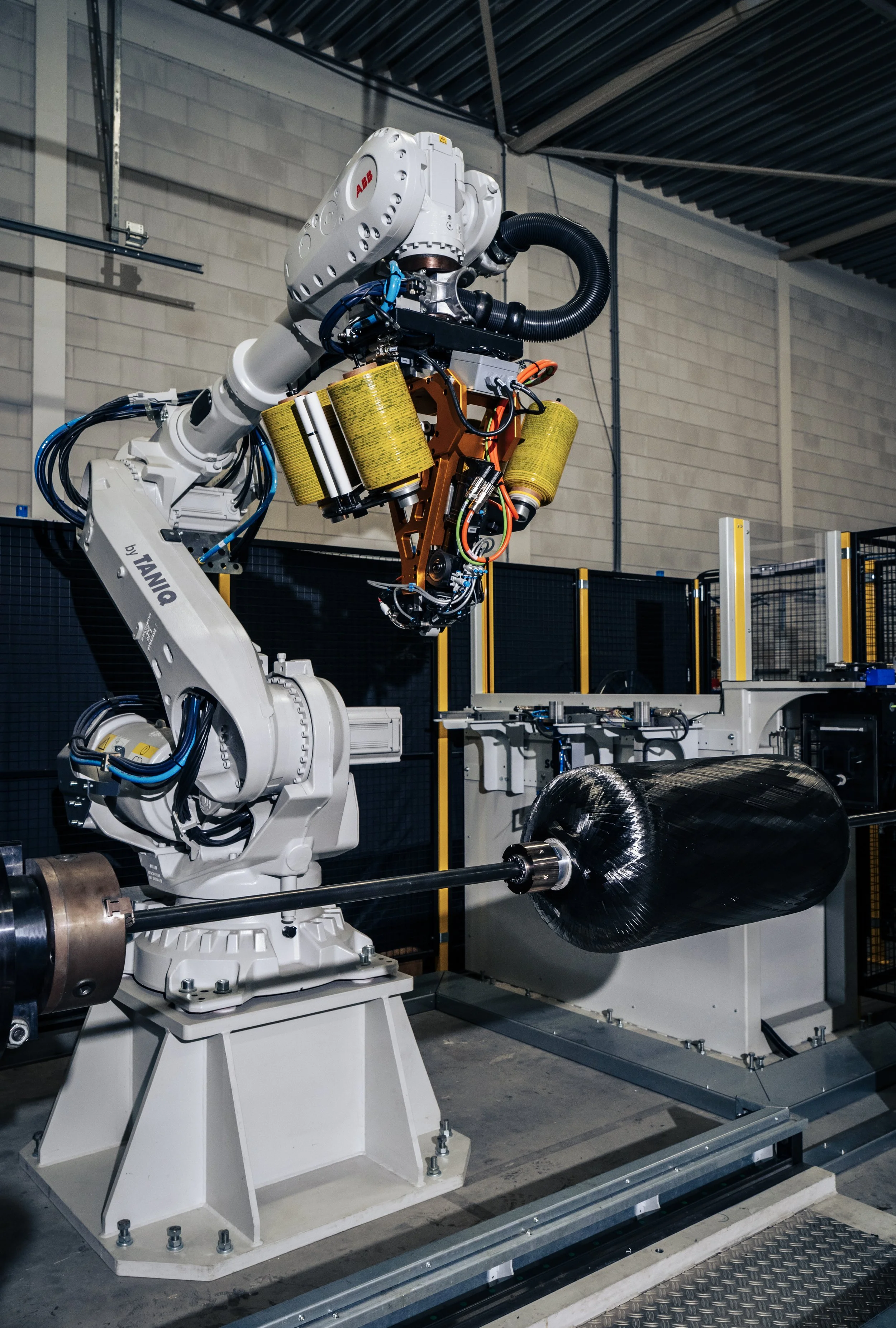
TANIQ robot with a dedicated AFP head
One Robotic Cell: Automatic Tool Switching
Software integration alone is not enough. the manufacturing system must be equally unified. TANIQ’s robotic winding system enables automatic tool switching within a single robotic cell. Depending on the required process step, the robot can switch between:
A dedicated high-speed Filament Winding head
An AFP head for localized reinforcement
A Rubber Winding head for elastomer integration
This setup eliminates mandrel transfer between separate machines. The product remains mounted in one setup while the robot executes different processes sequentially. This results in:
Continuous manufacturing
Higher product quality and repeatability
Significantly reduced lead times
Lower alignment and repositioning errors
Unique Capabilities in Rubber Winding
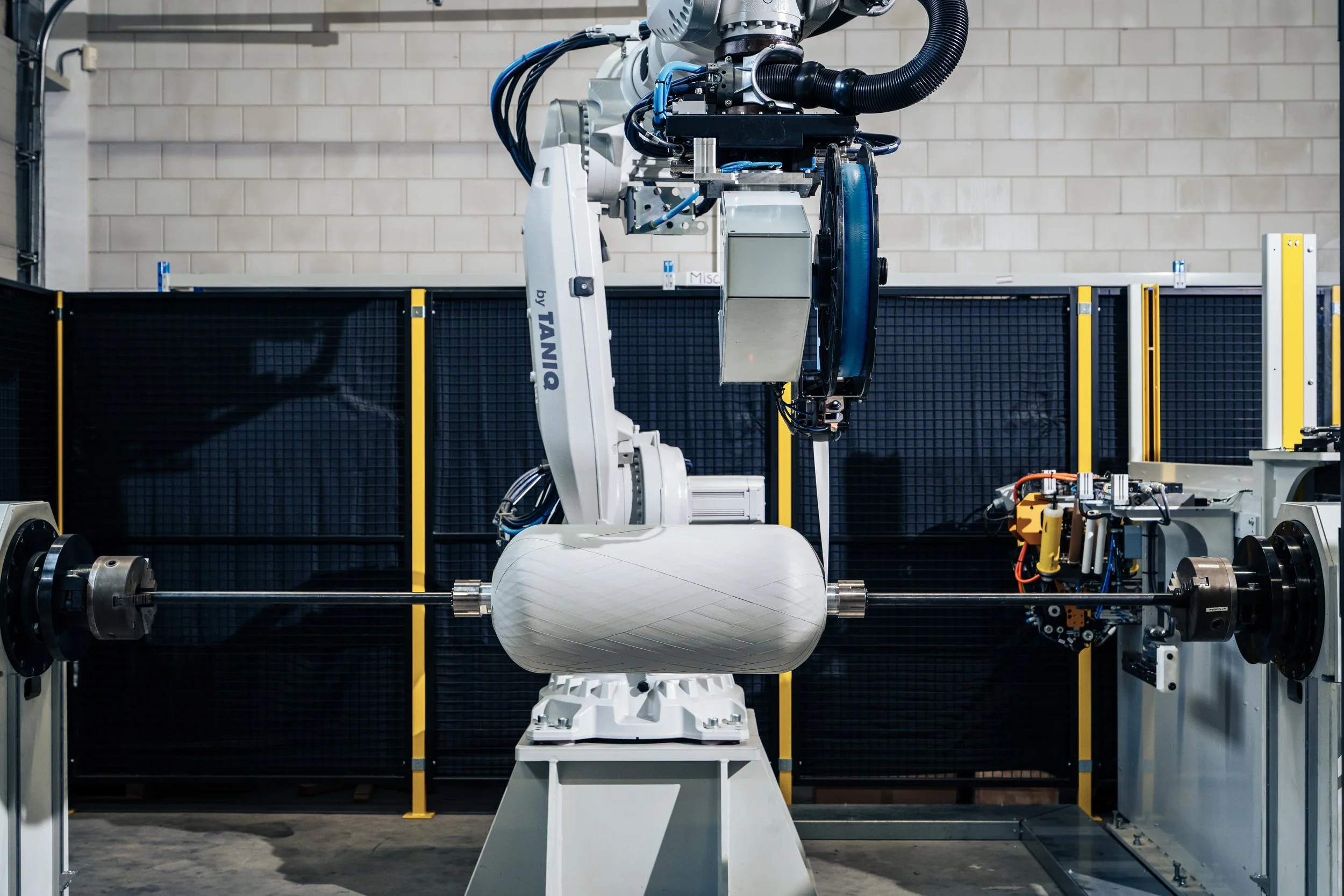
TANIQ robot executing rubber winding using a rubber tool
One of TANIQ’s strengths is advanced rubber composite automation. Since 2006, the company has developed specialized robotic systems for high-end reinforced rubber applications such as tires and marine hoses.
Rubber winding presents unique challenges:
Low-modulus material behavior
Complex path stability
Precision thickness control
TaniqWind Pro is the only software platform featuring dedicated Rubber Winding path functionality. Combined with TANIQ’s proprietary Rubber Winding Head and advanced control strategies, the system enables accurate elastomer layer integration for:
Sealing
Insulation
Protective layers
This capability expands composite manufacturing beyond purely fiber-based reinforcement.
Enabling New Product Architectures
By integrating filament winding, AFP, and rubber winding into one cohesive system, TANIQ enables manufacturers to rethink product architecture. Applications include:
Composite Overwrapped Pressure Vessels (COPVs)
Hydrogen storage systems
Rocket motor cases and aerospace structures
Composite-rubber hybrid products
Lightweight multi-material structures
What previously required multiple machines, separate setups, or manual operations can now be executed within one coordinated process chain.